AI & Machine Learning · Software & Product Systems
Kaskor ASR
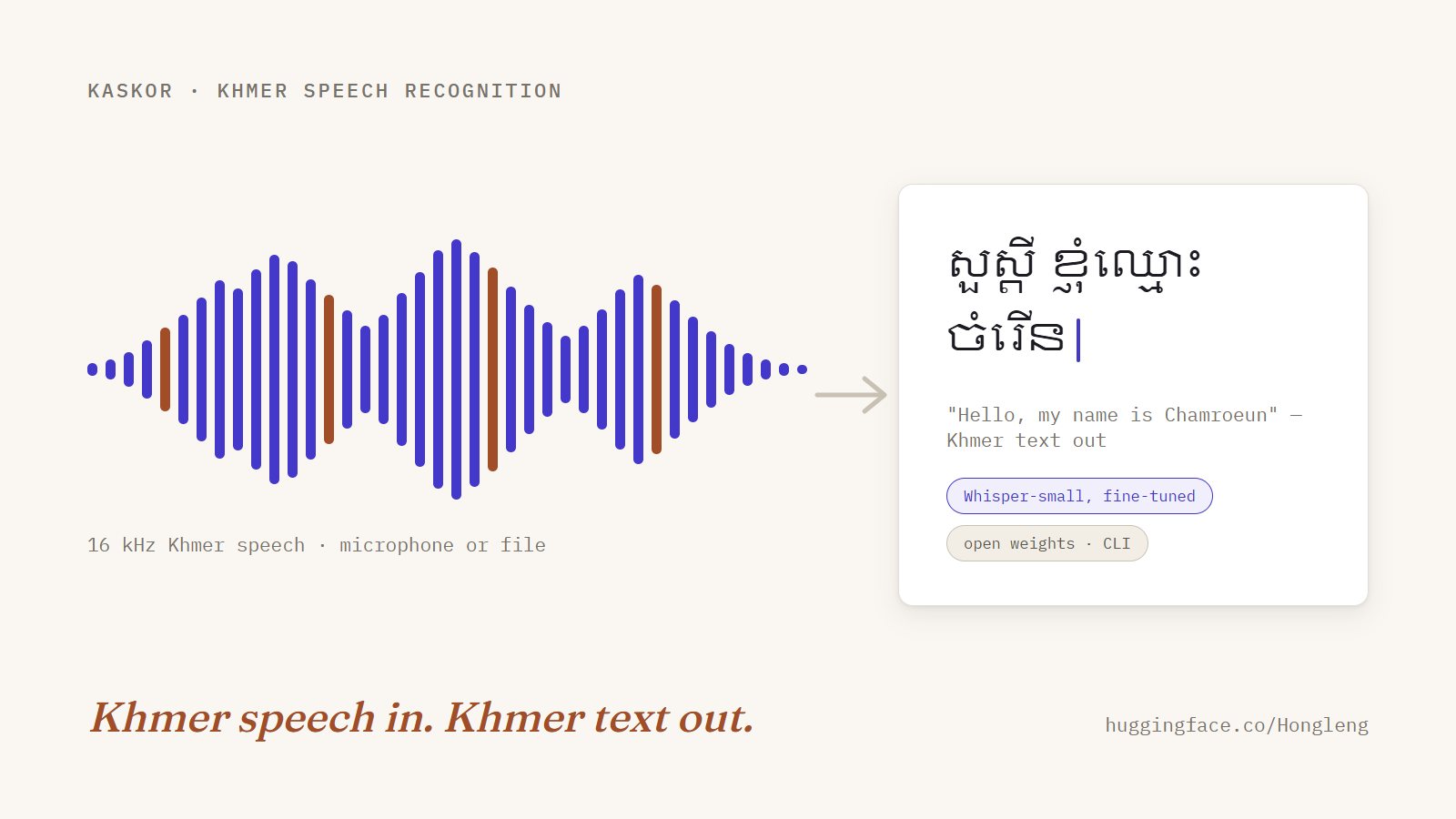
Khmer speech-to-text on a fine-tuned Whisper-small — 3.74% CER on a speaker-dependent validation split (self-reported) — public code, released weights, and an installable CLI.
Can a fully public fine-tuning pipeline — code, splits, and released weights — make Khmer speech recognition approachable with limited public data?
What problem this attacks
Khmer speech interfaces are held back by low-resource data, evaluation that standard word-based metrics get wrong, and research pipelines that nobody else can rerun. Most Khmer ASR work is not reproducible by a second person, which makes results hard to trust and harder to build on.
Who it serves
Developers and researchers who need Khmer speech-to-text building blocks, and — eventually — voice-first products for Khmer speakers, starting with agricultural data intake where typing is impractical.
Why it matters
Speech is the natural interface for many Khmer-speaking users, especially in field contexts. Because the training and evaluation code is public, every future improvement in data or compute can translate into a better model instead of a new unverifiable claim — even though the raw audio itself stays private.
What I actually did
My exact role
Sole builder of the public pipeline: data preparation, training and evaluation scripts, CLI packaging, and documentation.
Team contributions
Independent project.
What was researched and validated
Research
Studied why word error rate misleads for Khmer — the script does not separate words with spaces, so WER punishes segmentation choices rather than recognition quality. Character error rate became the primary metric, with WER kept only as a secondary signal, and the reasoning is documented in the repository.
Validation so far
Evaluation runs on a held-out split through the repository's own evaluation script, which now records the split, sample count, beam width, and decode limit with every result so two numbers are never compared across different settings. There is no external benchmark or third-party validation yet — the published numbers are self-reported and the README says so.
How the solution works
One repository that packages the entire path from raw Khmer audio to a trained, exportable model: dataset inspection, manifest building, resampling, speaker-stratified splitting, feature caching, training, evaluation, export, and a pip-installable transcription CLI for files, folders, and microphone input.
User workflow
- Inspect the raw audio dataset and build CSV manifests
- Resample audio to 16 kHz and verify formats so preprocessing cannot hide evaluation differences
- Split train/validation/test stratified by speaker
- Cache features, then fine-tune Whisper-small
- Evaluate with CER as the primary metric on the held-out split
- Export the model and transcribe through the CLI
System architecture
A staged pipeline of eleven Python scripts with explicit inputs and outputs. Raw audio stays outside git by design; the versioned repository holds manifests, scripts, and evaluation logic, and the fine-tuned weights are published separately on Hugging Face — so both the recipe and the resulting model are public even where the audio cannot be.
Methods
Fine-tuning openai/whisper-small with Hugging Face Transformers, torchaudio preprocessing, speaker-stratified splits, feature caching for iteration speed, and CER-first evaluation chosen for the linguistics of Khmer script.
Business, rules, and risk
Business value
An enabling layer rather than a product: reliable Khmer speech-to-text lowers the cost of every voice-first product idea that follows, including agricultural data intake for the Chomkar direction. Framed as potential — no commercial use exists yet.
Contracts & policy considerations
The code is MIT-licensed and public, and the fine-tuned weights are published on Hugging Face. The real commercial-legal question is dataset rights: audio provenance, speaker consent, and licensing must be documented before the raw audio or any dataset is released — which is why the recordings themselves stay private.
Data & privacy
Voice recordings are personal data. Raw audio is excluded from the repository, and any future release of weights or datasets requires documented consent and a provenance review first.
Risks
- A single aggregate metric can overstate quality for underrepresented speakers, dialects, or noisy environments
- Published numbers could be mistaken for production-grade accuracy claims
- Voice data misuse — any future dataset release without consent review would harm real speakers
What exists and what the evidence shows
Technical decisions
- Character error rate as the primary metric, because Khmer does not reliably separate words with spaces
- Every evaluation records its split, sample count, beam width, and decode limit, and results from different settings are never compared — the guard that would have caught the truncated-decode error earlier
- Raw audio stays outside git; manifests, scripts, and evaluation logic are versioned, and the fine-tuned weights are released on Hugging Face
- The full training pipeline is separate from the lightweight CLI that transcription users install
- Text normalization and 16 kHz verification happen explicitly, so evaluation differences cannot hide inside preprocessing
Completed work
The receipts
Results
What limits it, and what I learned
Constraints (imposed)
- Limited public Khmer speech data; reproducing training requires access to the source audio and suitable compute
- Raw audio cannot be responsibly published until dataset provenance and consent are documented
- Evaluation is a single held-out split, not per-condition analysis, and the split shares speakers with training — every training voice is female, so no result here estimates accuracy on an unheard speaker
- The test split has not yet been re-scored at the corrected decode limit, so the current figure comes from the validation split
Tradeoffs (chosen)
- Whisper-small over larger models, trading headline accuracy for iteration speed on available compute
- Audio stays out of git; the weights live on Hugging Face, so running inference means installing the CLI and pulling the v0.0 checkpoint
Lessons learned
- A decode limit is part of the metric, not a runtime detail: a 225-token cap made my own headline CER wrong by a wide margin, and nothing in the training logs showed it — only a per-utterance breakdown did
- Metric choice is a linguistic decision before it is a technical one — CER vs WER changes what 'better' means for Khmer
- Normalization and resampling silently distort evaluation unless they are explicit, versioned steps
- Reproducibility discipline (manifests, splits, scripts in git) is what turns a personal experiment into something others can build on
What gets validated next
- Hold speakers out of training entirely and re-measure — the number that would say what this model does for a new voice
- Re-score the test split at the corrected 448-token decode limit
- Evaluate by speaker, province, recording device, and noise condition
- Measure latency and accuracy inside a real voice-first product workflow